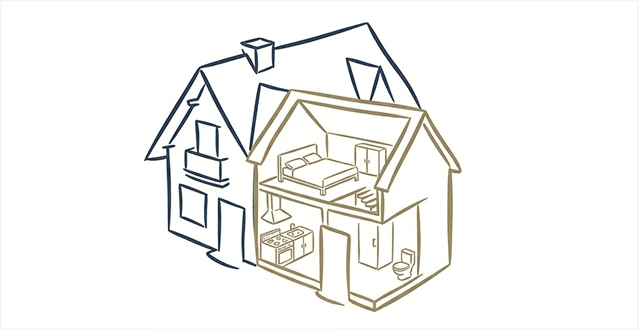
home extension
Expand your existing home by adding a new wing, level, or attached addition. Ideal if you want more space within the main structure — extra bedrooms, a sunroom, or an expanded living area that becomes part of the primary residence.
— Seattle ADU rules 2026
The three kinds of unit, what each costs, how long the permit takes and the zoning rules that apply to most Seattle single-family lots. For your own lot, the address form gives you a written answer within 1 business day.
All three are ways to add independent living space to your property. The right choice depends on your goals, lot, and budget.

Expand your existing home by adding a new wing, level, or attached addition. Ideal if you want more space within the main structure — extra bedrooms, a sunroom, or an expanded living area that becomes part of the primary residence.

A fully self-contained accessory dwelling unit attached to or inside your home — basement apartment, garage conversion, or side addition with its own entrance, kitchen, and bathroom. Often called a mother-in-law suite or in-law apartment. Legal to rent out long-term or short-term in Seattle.
★ Can be sold separatelyA completely standalone cottage or home built in your backyard with no shared walls — a backyard cottage, granny flat, or guest house. Maximum privacy for tenants or family. Adds the most equity and rental income potential of all three options — and qualifies as a separate legal dwelling unit under Seattle zoning.
— ADU Cost & Permits in Seattle
Our finished projects came in at $216,300 for a 400 sq ft studio DADU, $292,700 for a 576 sq ft one-bedroom cottage with a loft and $373,000 for an 854 sq ft two-bedroom attached ADU, each on one fixed-price contract covering design, engineering, permits and construction. Garage conversions come in lower; premium finishes and difficult sites push higher.
On permitting, plan for roughly 4–5 months for a DADU permit within the City of Seattle and about 2 monthsin unincorporated King County — timelines vary by jurisdiction and review load. Seattle’s pre-approved DADU plans cut that to 2 to 6 weeks. Evercrest handles the full permit process for you.
These are typical ranges for planning only — your exact cost and timeline come from a free ADU feasibility review.

— Seattle ADU Regulations 2025–2026
Seattle adopted permanent Neighborhood Residential (NR) zoning — the rules that cover most single-family lots — in February 2026 (Council Bill 120993), building on Washington's statewide ADU laws (HB 1337 and HB 1110). Here are the key rules for your property.
Up to 4 total dwelling units on any Neighborhood Residential (NR) lot — configured as detached cottages, townhouses, stacked flats, or any combination. Up to 6 units if the lot is within ¼ mile of a major transit stop or includes 2 affordable units. At most two of the units can be ADUs (Council Bill 120993, in force since January 21, 2026).
Maximum gross floor area per ADU in NR zones. Actual buildable size also depends on your lot's Floor Area Ratio (FAR) — the ratio of total floor area to lot size — and lot coverage; on smaller lots, these limits may restrict you below 1,000 sq ft.
In NR zones — same as the principal dwelling, plus an allowance for pitched roofs. Up to 42 ft where large trees are planted or retained, or a Tier 2 tree is kept. Two-story DADUs are now fully possible.
Standard minimum from side and rear property lines for an ADU. Zero setback where the rear yard abuts an alley. Buildings must be at least 5 ft apart. Front setbacks follow the lot's zoning: 15 ft with one or two units, 10 ft with three or more.
You can rent out both your main home and ADU/DADU without living on the property. Owner-occupancy requirement was eliminated by 2019 reforms and reinforced by HB 1337 in 2025.
Off-street parking requirements eliminated for ADUs. You can include parking based on your needs, but the code does not require it. Reduces cost and enables projects on smaller lots.
For lots with multiple dwelling units, maximum lot coverage increased from 35% to 50%. On a typical 5,000 sq ft lot, this means 2,500 sq ft of building footprint — enough for a primary home plus additional units.
ADUs are exempt from Seattle's MHA affordable-housing payment and from street-improvement requirements, regardless of zone. The King County sewer capacity charge still applies to a new connection, billed monthly for 15 years.
Your address first. Within 1 business day you get what fits, what it costs and how long the permit takes.
/ faq
Yes — in Seattle you can legally rent out your ADU (long-term or short-term), as long as it is properly permitted and registered. ADUs are allowed as rental units under Seattle zoning and building codes. There is no owner-occupancy requirement, meaning you do not need to live in the main house or the ADU in order to rent it out.
Yes — we manage the full permitting and city approval process for ADU, DADU, and extension projects. This includes preparing all required documentation, coordinating with architects and engineers, submitting plans to the City of Seattle, and guiding the project through plan review, inspections, and final approval to ensure full compliance with building codes and regulations.
Yes — in many cases, you can legally convert an existing garage into an ADU in Seattle, as long as the structure meets current zoning, building code, and safety requirements. The garage must be permitted, upgraded for insulation, plumbing, electrical, and egress, and approved through the city's plan review and inspection process. Feasibility depends on property layout, utility access, and Seattle ADU regulations. We assess this during your free consultation.
Yes. An ADU above a garage is one of the most space-efficient options on a Seattle lot: parking or storage stays below and a full apartment with its own stair and entrance goes on top. Over an attached garage it is permitted as an attached ADU; over a detached garage it counts as a DADU, with up to 32 feet of height allowed in Neighborhood Residential zones. Most existing garages were not framed or founded to carry a second story, so we start with a structural check — sometimes the garage is reinforced, sometimes it is cheaper to rebuild it as part of the project.
Yes — a mother-in-law suite is simply an ADU built for family. It can be an attached unit with its own entrance, a converted basement or garage, an apartment above the garage, or a detached backyard cottage. For aging parents we plan it step-free where the lot allows: a no-threshold entry, a walk-in shower, wider doors and a bedroom on the main level. It is permitted as a legal dwelling unit, so it can become a rental later.
Under Seattle's 2025 zoning updates (HB 1337 and HB 1110 compliance), you can build up to two ADUs per lot that contains a principal dwelling unit. Both can be detached (two DADUs), or any combination of attached and detached. Some lots near major transit stops can accommodate up to 6 total units. Two DADUs can even be located in the same structure. ADUs count toward overall density limits.
Standard: 5-foot setback from side and rear property lines. If your property borders a back alley, you can build with zero setback on the alley side. Front setbacks follow standard zoning rules. When a DADU exceeds 18 feet in height, Seattle requires increased setbacks from property lines. These requirements apply across all NR zones (NR1, NR2, NR3, and RSL zones).
Each ADU can be up to 1,000 sq ft of gross floor area in most NR zones. The actual buildable size also depends on your lot's Floor Area Ratio (FAR up to 1.2 depending on zone) and lot coverage limits. Conversions of existing structures (basements, garages) may exceed the 1,000 sq ft limit. Minimum lot sizes no longer apply for ADUs.
Yes. Under the 2025 rules, DADUs can be up to 32 feet tall in Neighborhood Residential zones and up to 40 feet in other areas. The ridge of a pitched roof can extend an additional 5 feet above the height limit within a 4:12 sloped envelope. This means two-story DADUs are now fully possible and increasingly popular for maximizing space on smaller lots.
Get a free, no-obligation site assessment. We'll evaluate your property, walk you through the permit process, and give you a realistic budget range — all at no cost.
/ For homeowners and property owners in Seattle & King County only